The Destination Wedding Welcome Dinner That Sets the Tone
A destination wedding welcome dinner in France, done properly: the long table, the regional menu, the 19h30 start, what it costs and what to leave out.
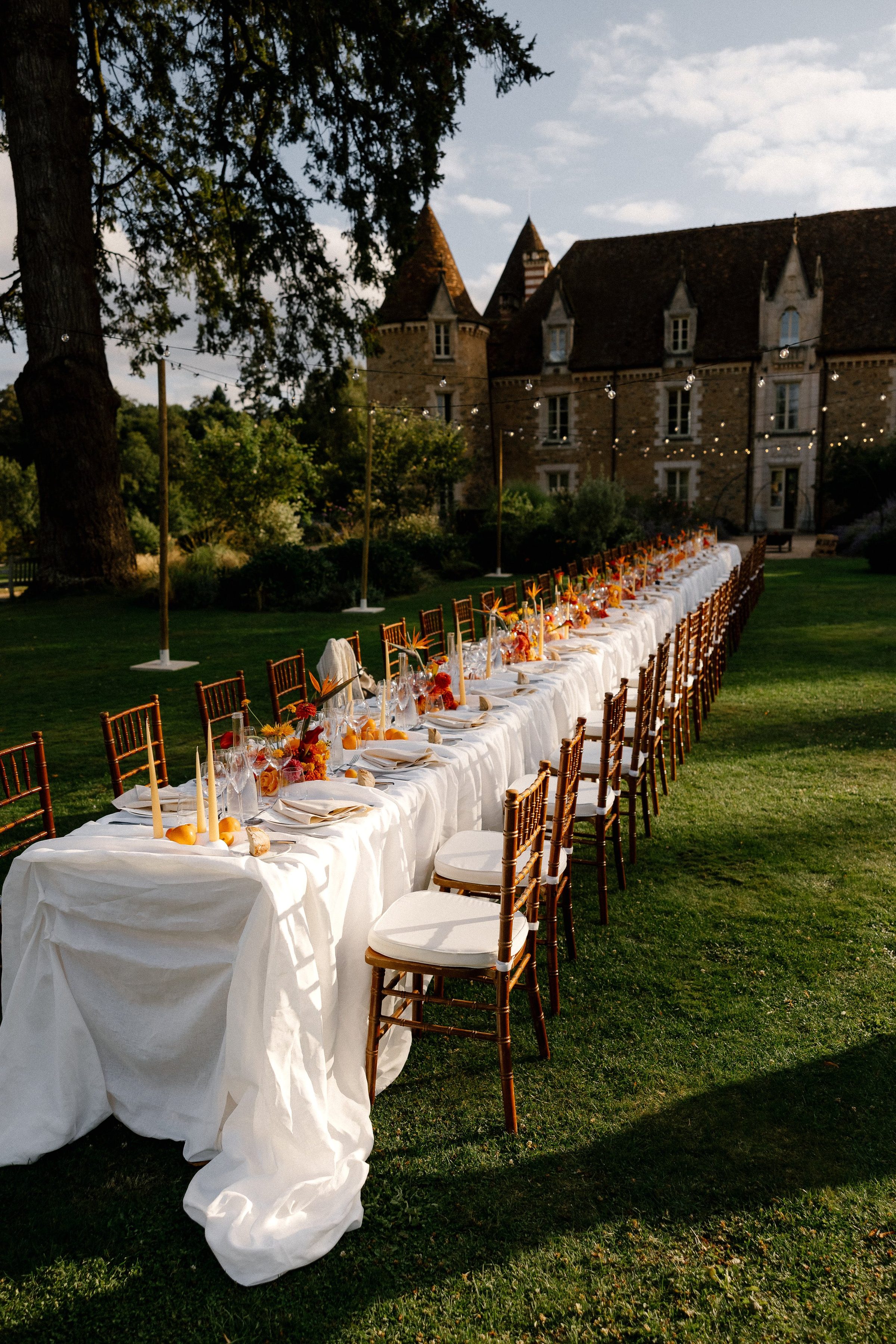
At half past seven on a June evening in Provence the terrace of a village restaurant is still in full light, the stone is warm underfoot, and forty people who have mostly never met are finding their names along a single table that runs the length of it. A guest from the groom's side is pouring wine for someone he met four minutes ago. The bread has gone round twice. Nobody has made a speech. That is what a destination wedding welcome dinner should look like, and it should look as little like the wedding as possible. If the wedding is a seated dinner in the grand hall of a chateau, the first evening belongs at a long table on a restaurant terrace. If the wedding is in a garden, hold the welcome dinner in a small dining room in the nearest village.
For many of your guests this will be their first evening in France. They have traveled a long way and most of them do not know each other. Seat them at one table on the first night and the introductions are done before the ceremony. Skip it, or leave it to chance, and they meet for the first time in the ceremony rows.
The Long Table and the Passed Platter
A single long table, or a run of tables that reads as one, is the format we return to most often. It creates proximity. Guests who would otherwise cluster with the people they already know find themselves beside someone new, and the physical closeness of a long table draws out conversation in a way that rounds of eight do not.
Serve family-style. Platters in the center of the table, shared and passed, do more for the atmosphere than individual plating. Offering the bread basket and pouring wine for a neighbor are small acts that dissolve the formality of sitting among strangers. Nobody waits for a course to be cleared before the next arrives. There is a view in our office that the passing of a platter is the single most useful thing that happens all weekend, because it obliges two people to look at each other, say something, and hand over a dish of lamb, and after that they are no longer strangers; the other view is that the wine does it and the platter is only the excuse. Either way, do not plate individually on the first night.
Keep the program to almost nothing. No speeches, no toasts, no first dance, no structured entertainment. A brief word from the couple, thanking everyone for traveling and saying what it means to have them there, is welcome. If a parent or close family member wants to say a few words, that is fine, but limit it to one or two people and keep them short. Anything more begins to borrow from the wedding day.
Do use place cards, even for an informal evening. You do not need the complexity of the wedding seating plan, but some intention about who sits beside whom changes how the evening feels.
Where to Hold a Destination Wedding Welcome Dinner
A private dining room or terrace at a local restaurant is usually the right answer. The restaurant carries the production, your guests get their first encounter with the region's cooking, and the setting is a change of scene from the wedding venue. In the south of France, waterfront restaurants and village bistros both work. The questions to ask are practical: can it seat the full guest list privately or semi-privately, is the food good and of the region, is it within reasonable reach of where guests are staying, and is the room warm rather than formal.
One of our favorite welcome evenings was at Le Moulin in Lourmarin, the restaurant with rooms run by Le Galinier, the night before a wedding there. We brought in a crêpe stand, and guests stood around with a glass of wine and small plates, meeting each other and catching up while the crêpes came off the griddle. Afterward everyone walked back to their hotels and rentals through the village.
If guests are staying at the wedding venue itself, a chateau or a hotel, hosting the dinner there is sensible, provided you use a different space. Wedding dinner in the formal dining room, welcome dinner in the courtyard. Wedding in the garden, welcome dinner on the terrace.
For American guests in particular, dinner at a French vineyard is a new experience. In wine country, Provence, the Rhone, Bordeaux, it does double duty as the weekend's first excursion: a walk through the vines, a tasting, then dinner in the chai or on a terrace above the rows with the last of the light on them.
The Menu Is the Region
Serve what the region does best, in quantity. This is the wrong evening for a seven-course tasting menu or anything experimental.
In Provence, that might be charcuterie and local cheeses to start, then roast lamb or fish en croute with the season's vegetables, and fresh fruit and tarts to finish. On the Riviera, grilled fish, salade nicoise and ratatouille. In Bordeaux, duck confit, entrecote and caneles.
The wine should be local and there should be a lot of it. The first evening is the moment to introduce your guests to the wines of the place they are standing in. Have the bottles on the table from the start, not poured from a side station.
Timing: 19h30, and Let It End Itself
Most welcome dinners take place the evening before the wedding, which gives guests who landed that day time to check in, shower and settle. A start between 19h30 and 20h00 works in summer, when the light in the south of France is still gold at that hour.
Let the evening end on its own. By 22h30 to 23h00 most guests will be ready for bed, particularly after a day of travel. Do not program it to run until midnight. The wedding is tomorrow, and everyone, including you, needs the rest.
Where guests arrive over several days, a standing welcome drinks reception of one to two hours, with canapes and wine, is a lighter alternative. It absorbs staggered arrivals and asks far less in production than a seated meal.
What It Costs
Plan for the welcome dinner from the outset; finding the budget for it later is harder. A seated dinner at a restaurant in the south of France runs EUR 80 to EUR 150 per person including wine, depending on the restaurant and the menu. For 80 guests, that is EUR 6,400 to EUR 12,000.
Hosting at the wedding venue with external catering costs more, because you are paying for the production: table setup, service staff, tableware rental. Budget EUR 120 to EUR 200 per person in that case.
Decide early who is hosting. In American wedding culture the rehearsal dinner is traditionally given by the groom's family, and that convention often carries over to the destination wedding welcome dinner. Settle it before the menu, because whoever hosts will have views on the menu.
What to Leave Out
Resist over-producing it. Once there are elaborate florals, a DJ, a running order and a formal seating chart, it has become a second wedding.
Invite everyone. Unless the dinner is genuinely a small family affair, in which case call it a family dinner, every wedding guest should be at the table.
Do not schedule anything afterward. Some guests will carry on at the bar or on the terrace, and that should be allowed to happen on its own.
Three Small Things Guests Notice
Introduce people. The couple, or someone in the wedding party, should make a deliberate effort during dinner to connect guests who do not know each other. In the excitement of the evening it is natural for the couple to spend the whole dinner with the people they are most comfortable with. This is the evening to circulate.
Print a menu. One card at each place, listing the dishes and the wines, on good paper and well set.
A small welcome gift at each place, olive oil, lavender soap, a box of calissons from Aix, is not essential, but it is the sort of thing guests take home.
Frequently Asked Questions
Do we have to host a welcome dinner?
No, but for a destination wedding where guests have traveled internationally, we recommend it without hesitation. Guests who have made the effort to travel notice being gathered and looked after on their first evening, and on the wedding day the ceremony rows fill with people who ate together the night before.
What time should the welcome dinner start?
19h30 to 20h00 is standard for summer celebrations in France, when the light is still good at that hour. Let the evening end naturally by 22h30 to 23h00, so that everyone is rested for the wedding day.
Can we host the welcome dinner and the wedding at the same venue?
Yes, provided you use a different space. If the property has a courtyard, a terrace and a formal dining room, use one for the welcome dinner and another for the wedding, so the two evenings feel like distinct events.
A useful first step, before any planner is involved, is to ask your wedding venue for the names of two or three restaurants nearby that can seat your full guest list privately, and then eat at each of them on an ordinary evening.
